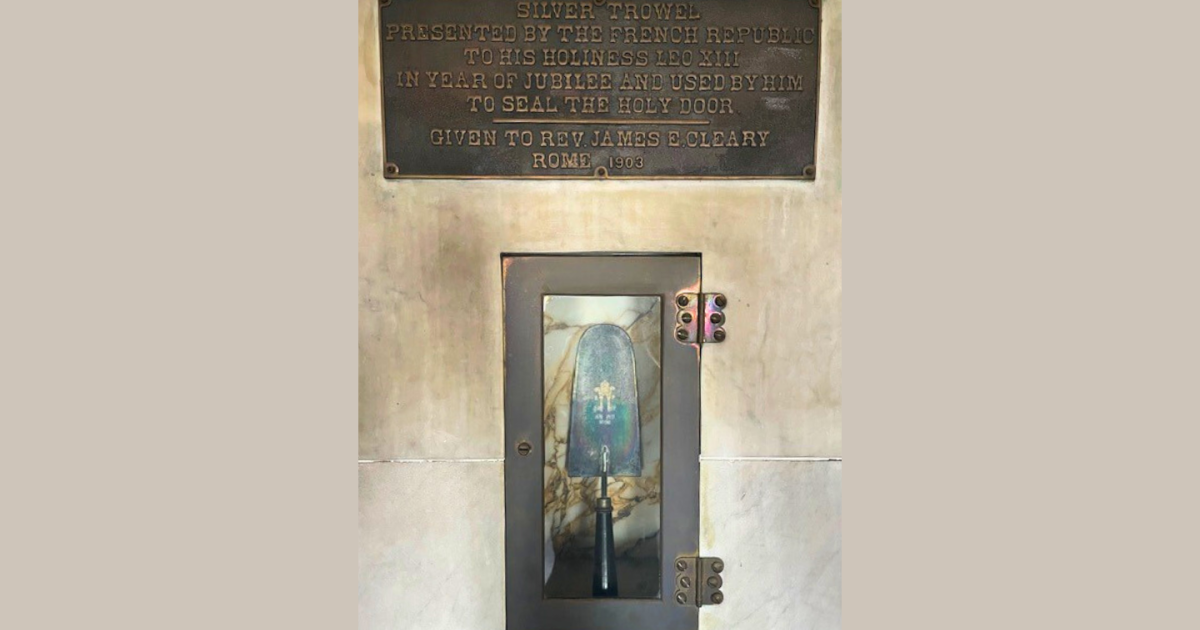
In a quiet niche behind the high altar of St. Peter the Apostle Church in Reading, a piece of Catholic history rests under glass: a handmade silver trowel once used by Pope Leo XIII to seal the Holy Door at the conclusion of the Jubilee Year of 1900.
The trowel bears an engraved papal seal featuring two keys, symbolizing the heavenly and earthly authority of the Church. It was presented to Pope Leo XIII by the French Republic for use in the ceremonial closing of the Holy Door at St. Peter’s Basilica, a ritual marking the end of the Jubilee celebration.
The Holy Door had been opened on Dec. 24, 1899, inaugurating what Pope Leo XIII proclaimed a universal Holy Year. It was the first of four ordinary Jubilees of the 20th century and came at a time of profound social and industrial change.
That turn-of-the-century Jubilee was deeply influenced by Pope Leo XIII’s landmark 1891 encyclical, “Rerum Novarum,” which addressed “the new things” of the industrial age, including the rights and conditions of workers, the responsibilities of employers, and the role of government. The encyclical laid the foundation for modern Catholic social teaching.
Read more on AD Today.

ad-today.com
A Silver Link Between Two Popes Named Leo and Two Jubilees - AD Today
In a quiet niche behind the high altar of St. Peter the Apostle Church in Reading, a piece of Catholic history rests under glass: a handmade silver trowel once used by Pope Leo XIII to seal the Holy Door at … Continue reading