Ash Wednesday
No fixed feast day in the calendar
Flip the card and scan the QR code on the back to open it in the app
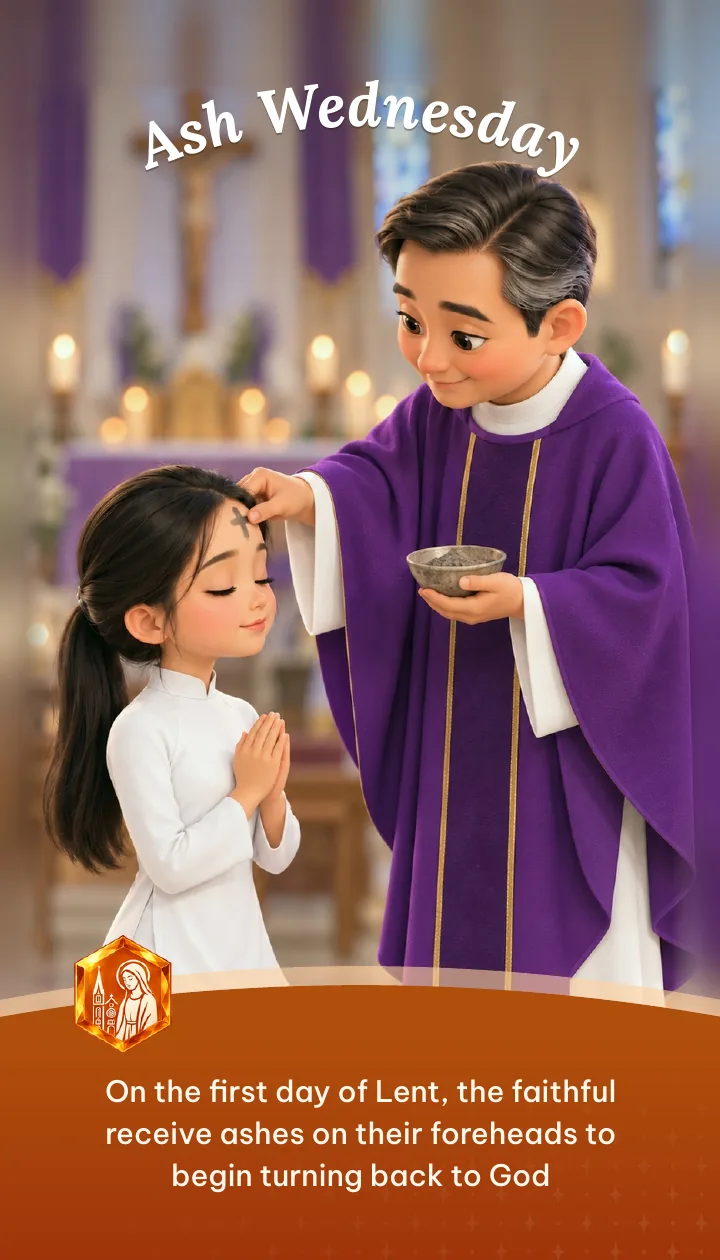
On the first day of Lent, the faithful receive ashes on their foreheads to begin turning back to God
What is this day?
Ash Wednesday is the first day of Lent, the forty days of preparation for Easter. At Mass, after the homily, the priest blesses the ashes and places them on the faithful, either by marking the forehead or by sprinkling the head, depending on the place. Under Church law, on this day the faithful from age 14 abstain from meat, and those aged 18 through 59 also fast, except those who are excused, such as people who are sick.
The story
Since Old Testament times, people who wanted to show they were sorry put on rough cloth and sprinkled ashes on their heads. The prophet Joel called the people: “Rend your hearts, not your garments” (Jl 2:13). This means that the outward sign must go together with a sorry heart: God wants us to change from within.
When giving the ashes, the priest says a short sentence taken from Scripture. One is based on Jesus’ call to repent and believe in the gospel (cf. Mk 1:15). The other is based on what God said to Adam, as the Book of Genesis records: “For you are dust, and to dust you shall return.” (Gn 3:19).
In the Gospel for Ash Wednesday, Jesus teaches the three practices of Lent: almsgiving, prayer and fasting, but done quietly, for the Father in heaven alone to see (cf. Mt 6:1-6, 16-18).
Why does the Church celebrate this day?
Because everyone needs to turn back to God. The ashes are not meant to make us sad, but to remind us that life is short, and that only in God do we have eternal life. The forty days of Lent help us follow Jesus, who fasted forty days and forty nights in the desert, so that we can go with him to the joy of Easter.
A lesson for you
- Choose one small sacrifice: fewer snacks, less gaming, one less complaint.
- Put some of your savings into a Lenten money box to help the poor.
- Spend extra time in prayer and go to confession to prepare for Easter.
Identifying marks
- A cross of ashes on the girl’s forehead: the ashes remind us that we are dust and need God to save us (cf. Gn 3:19); the shape of the cross shows that salvation comes from Jesus.
- A bowl of ashes in the priest’s hand: the ashes are made from the branches blessed on Palm Sunday the year before; the joy of that day now becomes a humble invitation to repent.
- The girl kneeling with her hands joined and her eyes closed, wearing a white áo dài, a traditional Vietnamese long dress: a Vietnamese Catholic’s humility and determination to turn back to God.
- The priest’s violet vestment and the violet cloth in the church: violet is the color of Lent, a season of repentance and preparation.
- The crucifix on the altar behind: Lent leads us to Jesus, crucified and risen.
The text on this page is the card in the Catholic Information app, word for word.
Compiled by i-Catholic · About