Palm Sunday of the Passion of the Lord
No fixed feast day in the calendar
Flip the card and scan the QR code on the back to open it in the app
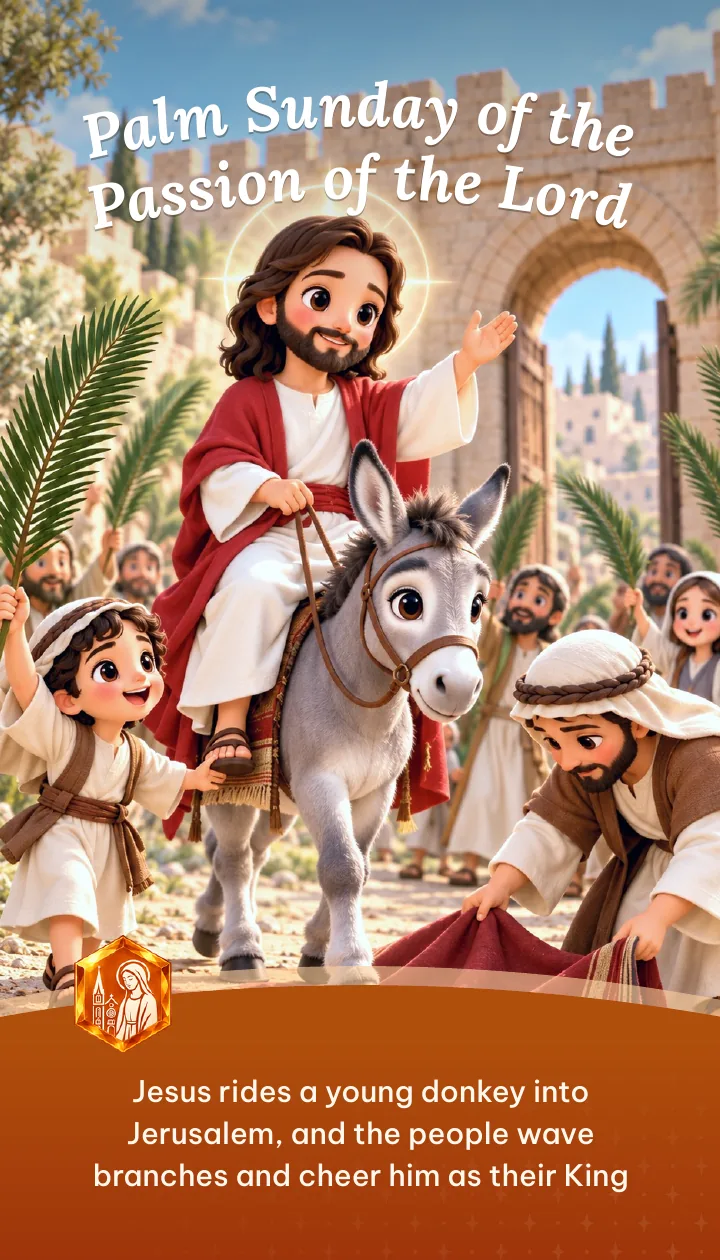
Jesus rides a young donkey into Jerusalem, and the people wave branches and cheer him as their King
What is this feast?
Palm Sunday is the Sunday just before Easter, and it opens Holy Week. The liturgy that day has two main parts. First, the priest blesses the branches and everyone carries them in procession into the church (in some places this may be a simpler rite), remembering the Lord’s entry into Jerusalem. Then the Church reads the Passion, the account of the Lord’s suffering and death. That is why the full name of the day is Palm Sunday of the Passion of the Lord.
The story
As they drew near to Jerusalem, Jesus sent two disciples into a village to bring back a donkey (cf. Mt 21:1-3). This fulfilled the words of the prophet, who said that the King would come to his people gentle and riding on a donkey (cf. Mt 21:5).
The disciples laid their cloaks on the donkey, and Jesus sat on it. A very large crowd spread their cloaks on the road, while others cut branches from the trees and scattered them along the way (cf. Mt 21:7-8). The Gospel of John says that the people “took palm branches and went out to meet him” (Jn 12:13). The whole city was shaken, and everyone asked: “Who is this?” (Mt 21:10).
In ancient Jerusalem these were date-palm branches; some Vietnamese Bibles call them sago palm leaves, and parishes in Vietnam also use sago palm leaves, so on the card the people are holding sago palm fronds.
Only a few days later, in that same Jerusalem, a crowd shouted for him to be crucified (cf. Mt 27:22-23). People’s hearts change so easily.
Why does the Church celebrate this feast?
The Church acclaims Jesus as King, but a gentle, humble King who comes to give his life for us. Many families take the blessed branches home and put them on the family altar, to remember that they belong to the Lord. This feast also invites you to walk the whole of Holy Week with the Lord, from today’s joy to the Cross and the Resurrection.
A lesson for you
- Carry your branch in the procession with real devotion, and sing to the Lord with all your heart.
- Stay faithful to the Lord in good times and hard times; do not let your heart change so easily.
- During Holy Week, spend extra time in prayer and take part in the liturgies.
Identifying marks
- Jesus riding a little donkey, his hand raised in blessing: he is a gentle King who comes not on a war horse but on a young donkey, to serve and to save.
- A boy waving a sago palm frond: the joy of welcoming the Lord; in Vietnam, Catholics also carry sago palm fronds in procession on this day.
- A man spreading his cloak on the road in front of the donkey: offering the Lord what we have, and welcoming him as a king.
- A stone city gate and high walls behind: the Lord enters Jerusalem, where he will die and rise again.
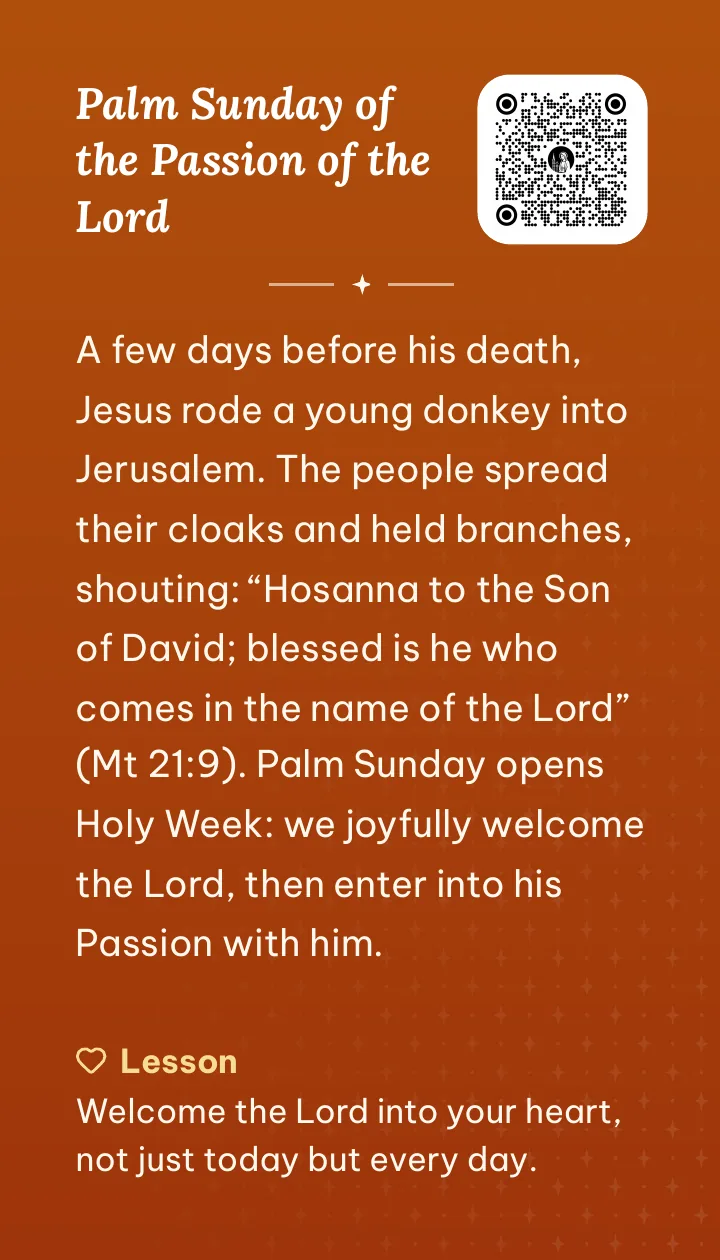
The text on this page is the card in the Catholic Information app, word for word.
Compiled by i-Catholic · About