Prophet Moses
No fixed feast day in the calendar
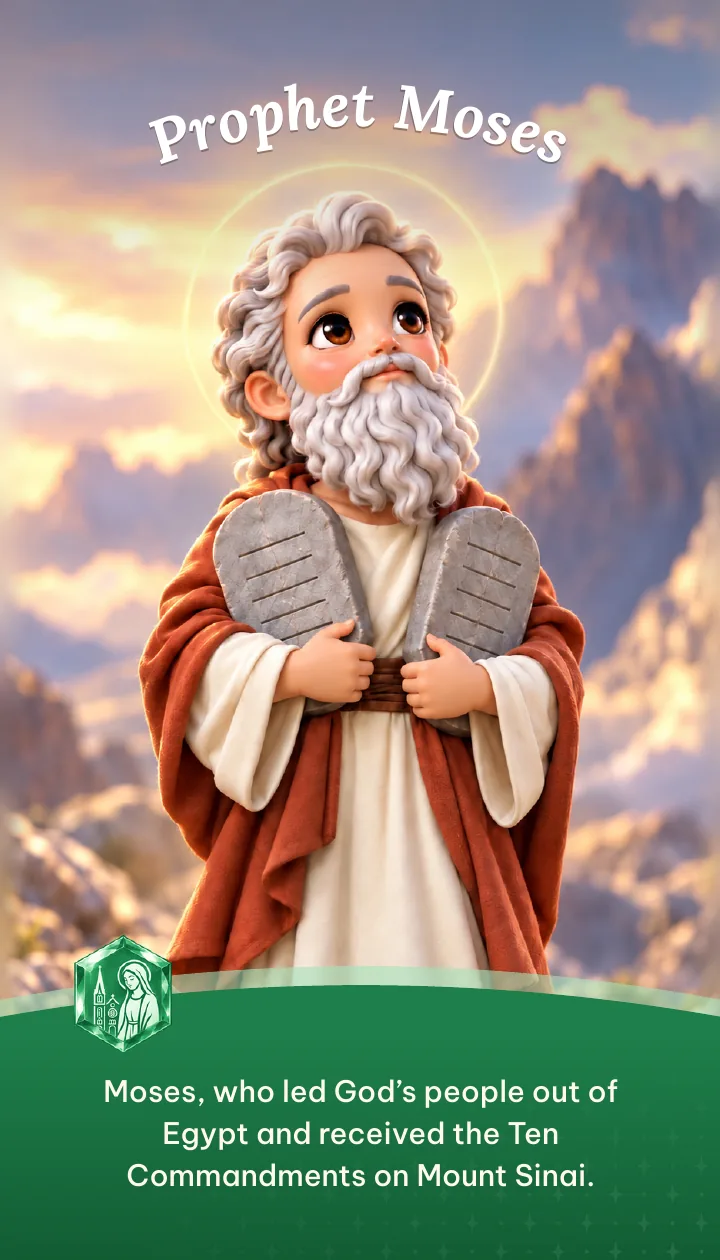
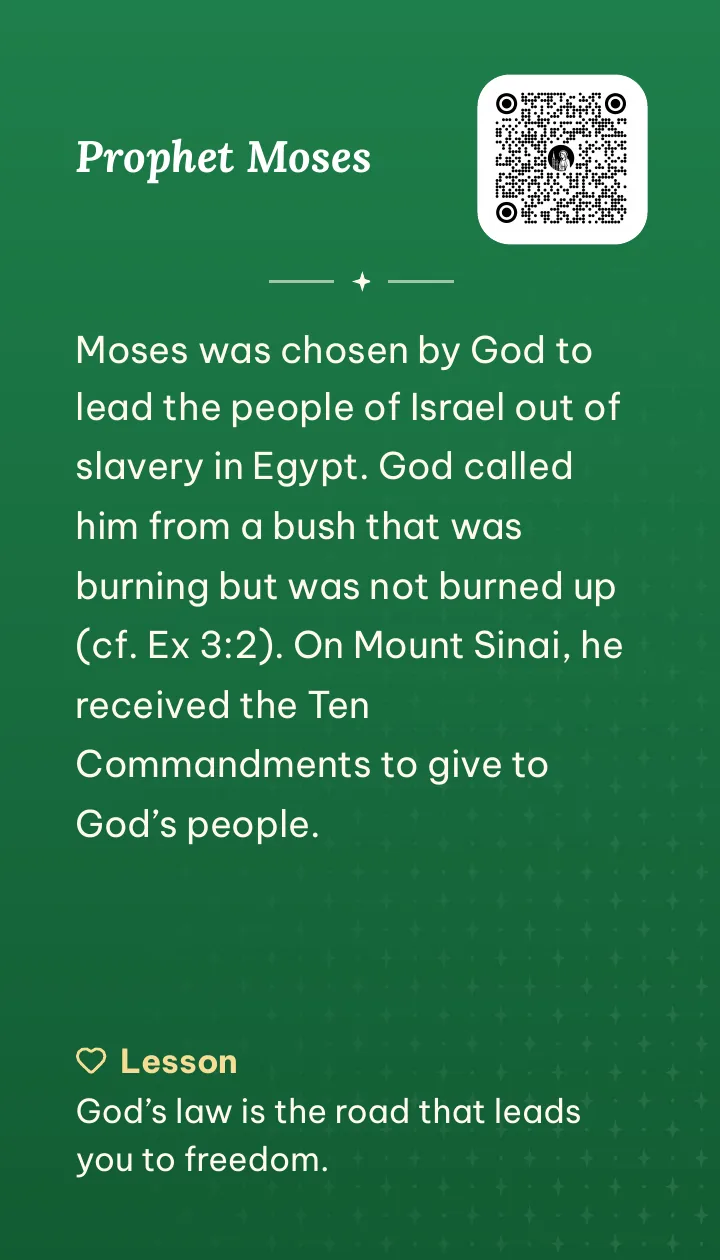
Flip the card and scan the QR code on the back to open it in the app
Moses, who led God’s people out of Egypt and received the Ten Commandments on Mount Sinai.
Who is he?
Moses is the greatest prophet of the Old Testament. Through him, God set the people of Israel free from slavery and gave them the Law. The Bible says: “Since then no prophet has arisen in Israel like Moses, whom the LORD knew face to face” (Dt 34:10).
Life story
He was born when the king of Egypt wanted to harm the baby boys of the people of Israel. To save her son, his mother put the baby in a papyrus basket and placed it among the reeds on the bank of the Nile (cf. Ex 2:3). Pharaoh’s daughter found him, felt sorry for the baby and adopted him. She named him Moses, “because I drew him out of the water” (Ex 2:10).
When he grew up, he had to flee to the land of Midian, where he became a shepherd. One day, at Mount Horeb, he saw a bush that was burning but was not burned up. From the middle of the bush, God called: “Moses! Moses!” He answered: “Here I am” (Ex 3:4). God sent him back to Egypt to ask Pharaoh to let God’s people go.
Pharaoh was stubborn, and Egypt suffered many plagues (cf. Ex 7–11). At last, the people of Israel were allowed to leave. At the Red Sea, Moses stretched out his hand over the sea, the water parted, and the people walked through the middle of the sea on dry ground (cf. Ex 14:21-22). For forty years in the desert, God fed the people with manna (cf. Ex 16:35).
On Mount Sinai, God gave him the Ten Commandments on two stone tablets (cf. Ex 20; 34:29). When he came down the mountain, the skin of his face was shining because he had spoken with God. At the end of his life, he was only allowed to see the Promised Land from far away, from Mount Nebo, and then he died in the land of Moab (cf. Dt 34:1-5).
Why does the Church honor him?
He trusted God with all his heart and patiently led a people who often complained. The Bible says he was “very humble, more than anyone else on earth” (Nm 12:3). The New Testament sees him as a sign pointing ahead to Jesus: the Law was given through Moses, but grace and truth came through Jesus Christ (cf. Jn 1:17). When Jesus was transfigured, Moses appeared and talked with him (cf. Mt 17:3). The Roman Martyrology remembers him on September 4.
A lesson for you
- The Ten Commandments are not a heavy burden: they are the road God has marked out so that you can live free and happy. Learn them by heart and live by them.
- When God calls you through your parents, your teachers or the voice of your conscience, be ready to answer “Here I am,” like Moses.
- When you are asked to lead others, like being a team captain or class leader, be patient and gentle like him.
Identifying marks
- Two stone tablets: God gave him the Ten Commandments on Mount Sinai, written on two tablets (cf. Ex 34:29).
- A glow around his head: when he came down the mountain, the skin of his face was shining because he had spoken with God (cf. Ex 34:29-30).
- An old man with white hair and beard, standing among rocky mountains: he led the people until he was very old, and the mountain behind him is Mount Sinai.
- The burning bush (*): where God called him, a bush that burned but was not burned up (cf. Ex 3:2).
- A staff (*): the staff God used to work wonders, as when Moses stretched out his hand over the Red Sea (cf. Ex 14:16).
(*) Only in some pictures and statues.
The text on this page is the card in the Catholic Information app, word for word.
Compiled by i-Catholic · About