Second Day of Tết: Remembering Our Ancestors, Grandparents and Parents
No fixed feast day in the calendar
Flip the card and scan the QR code on the back to open it in the app
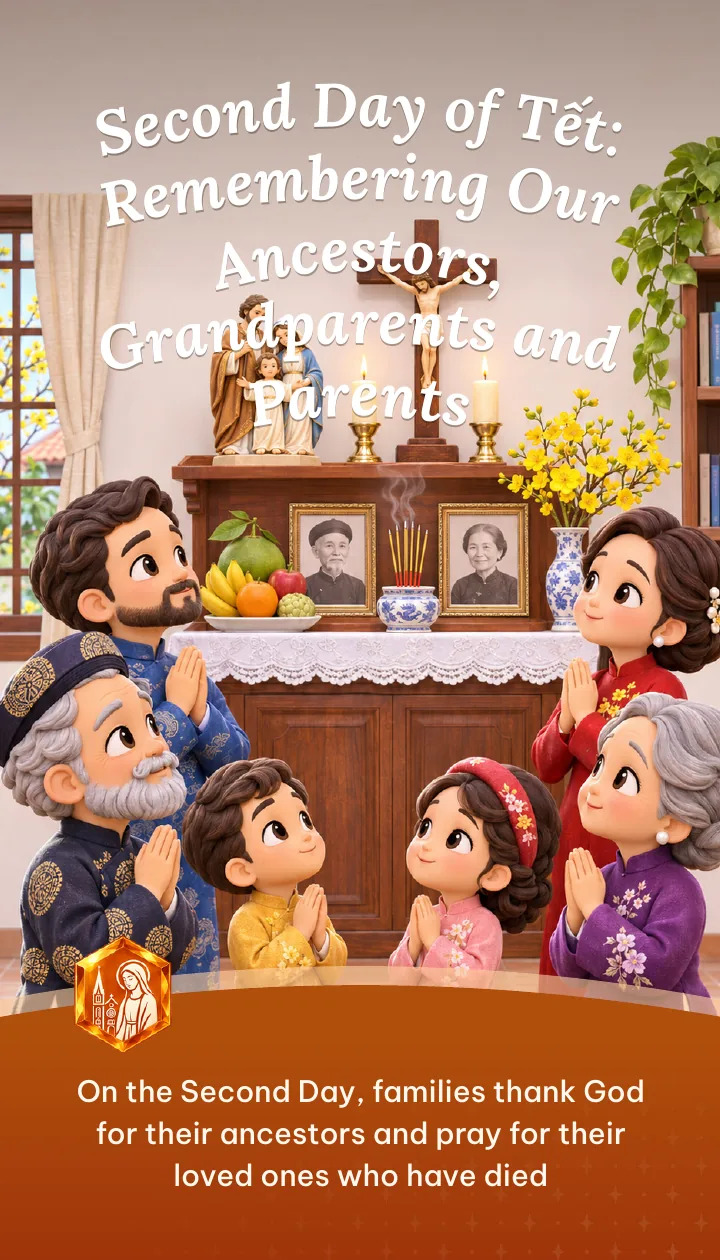
On the Second Day, families thank God for their ancestors and pray for their loved ones who have died
What is this feast?
The Vietnamese always remember the saying of their ancestors: when you drink water, remember its source. On the Second Day of Tết, the Vietnamese Lunar New Year, the Church in Vietnam offers a Mass to remember our ancestors, grandparents and parents: to thank God that they gave us life, raised us and handed on the faith, and to pray for those who have died.
The story
There was a time when Catholics were forbidden to take part in many rites honoring ancestors, because people feared they were a form of worshipping gods. In 1939, the Holy See issued the Instruction Plane compertum est, allowing gestures of honor and gratitude that now carry only the meaning of love and respect for one’s forebears. In 1964, the Holy See approved applying that instruction in Vietnam, and the Bishops of Vietnam guided the faithful. Today, following the guidance of the Bishops, Catholics may burn incense, light candles and bow before an ancestors’ altar placed below the altar of the Lord, as long as they avoid all superstition.
A reading of today’s Mass praises the holy people who came before us: “their virtues have not been forgotten.” (Sir 44:10). In the Gospel, Jesus strongly rebukes those who use offerings to God as an excuse not to take care of their parents (cf. Mt 15:1-6).
Why does the Church celebrate this feast?
The fourth commandment teaches us to honor our parents, and that gratitude does not stop when they die. Catholics believe that our grandparents and ancestors have not disappeared, because God “is not the God of the dead but of the living” (Mt 22:32). So we do not treat our grandparents like gods who send blessings or misfortune, but we pray that they may see the face of God, and we hope to meet them again in the Risen Christ.
A lesson for you
- Ask your parents the names and death anniversaries of your grandparents and ancestors, then pray for them.
- Wish a happy New Year to your living grandparents and take care of them: ask how they are, help them and respect them.
- When you burn incense before your grandparents’ photos, say a prayer for the souls of the faithful departed.
Identifying marks
- A cross at the highest place on the altar: God is always above all; the family remembers its ancestors in the Lord.
- A statue of the Holy Family: Saint Joseph, Our Lady and Jesus: the model for every Catholic family.
- Two framed photos of grandparents who have died, placed lower than the cross: following the guidance of the Bishops of Vietnam, the ancestors’ altar is placed below the altar of the Lord.
- An incense bowl, two candles and a plate of fruit: burning incense and offering fruit are gestures of remembrance and gratitude that the Church allows, not a way of feeding the dead or asking them for blessings as if they were gods.
- Three generations kneeling with hands joined: grandparents, parents and grandchildren pray together for those who have died.
- A vase of yellow mai blossoms: the joy of spring and of Tết, when the family gathers together.
The text on this page is the card in the Catholic Information app, word for word.
Compiled by i-Catholic · About