The Annunciation of the Lord
Feast day: March 25
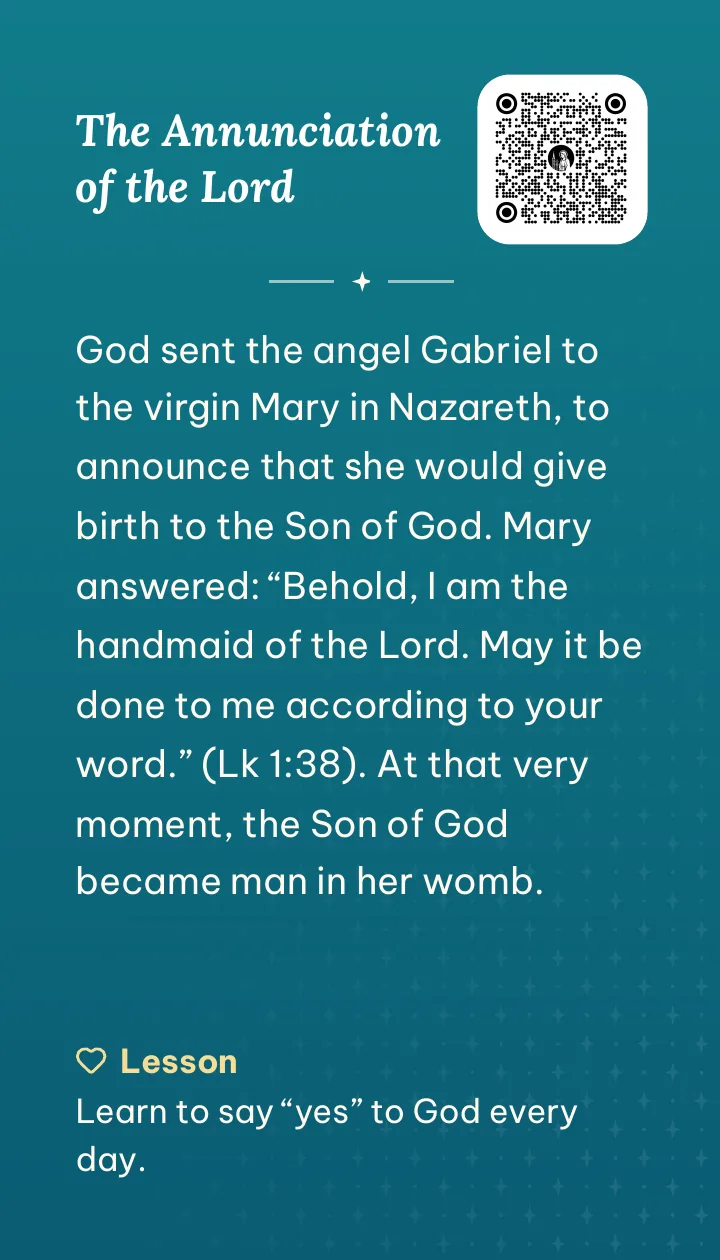
Flip the card and scan the QR code on the back to open it in the app
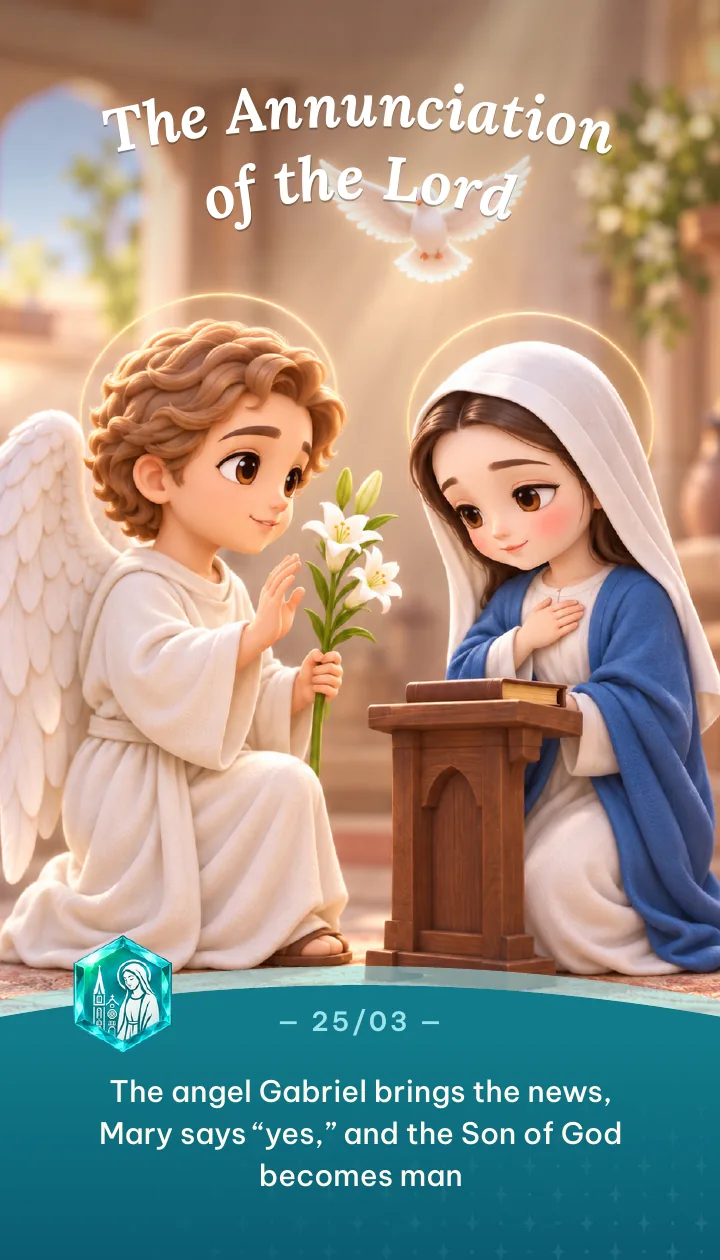
The angel Gabriel brings the news, Mary says “yes,” and the Son of God becomes man (25/03)
What is this feast?
The Annunciation celebrates the day the angel brought the news to Mary, and the Son of God became incarnate, which means he took on our flesh and became man in her womb. It is a feast of the Lord, and at the same time a feast very close to Mary. The 25th of March is exactly nine months before Christmas.
The story
God sent the angel Gabriel to the town of Nazareth, in Galilee, to a virgin named Mary, who was engaged to Saint Joseph. The angel said: “Hail, favored one! The Lord is with you.” (Lk 1:28). Mary was troubled and did not understand what this greeting meant.
The angel told her not to be afraid, because she would conceive and bear a son and name him Jesus; he would be called Son of the Most High (cf. Lk 1:30-33). Mary asked how this would happen. The angel answered that the Holy Spirit would come upon her, and added that Elizabeth, Mary’s elderly relative, was already six months pregnant, “for nothing will be impossible for God.” (Lk 1:37).
Mary did not understand everything, but she believed. She said “yes,” and the angel departed (cf. Lk 1:34-38).
The Gospel does not describe Mary’s room. The wings, the lily, the book and the kneeler are pictures from tradition that artists use to help us understand: Mary is a woman of prayer, pure, and listening to God’s Word.
Why does the Church celebrate it?
Because through Mary’s “yes,” the Son of God came to live among us to save all people. Three times a day, morning, noon and evening, many Christians pray the Angelus to remember this event. The angel’s greeting is also the first part of the Hail Mary.
A lesson for you
- When your parents or teachers ask you to do something good, say “yes” cheerfully, like Mary.
- Learn to pray the Angelus, especially at noon, to remember that God became man for you.
- When something is hard to understand, trust that nothing is impossible for God.
Identifying marks
- The angel kneeling on the left, with large white wings and a white robe, raising his hand in greeting: the angel Gabriel, sent by God to Nazareth.
- A white lily in the angel’s hand: according to tradition, the lily is a sign of Mary’s purity.
- Mary kneeling, her right hand on her heart: she humbly accepts and says “yes.”
- A wooden stand with a closed book: according to tradition, the angel came while Mary was praying with God’s Word.
- A white dove in a beam of light above Mary: the Holy Spirit comes upon her (cf. Lk 1:35).
The text on this page is the card in the Catholic Information app, word for word.
Compiled by i-Catholic · About