The Parable of the Good Samaritan
No fixed feast day in the calendar
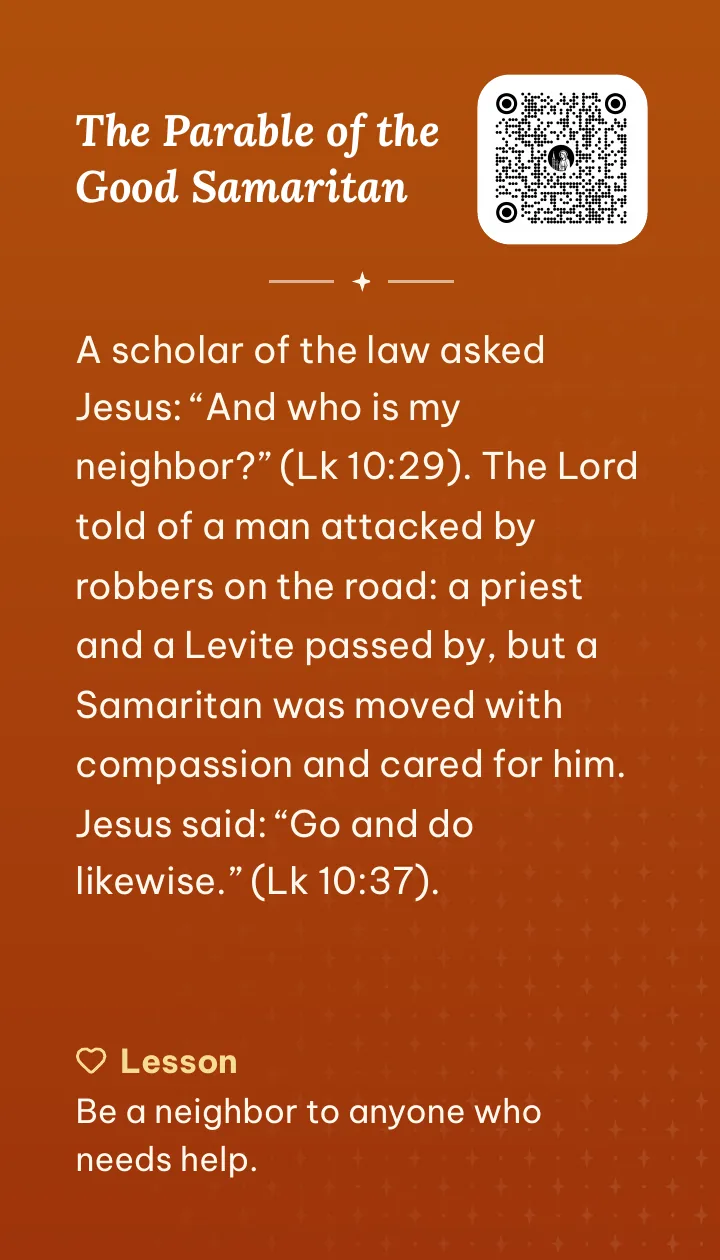
Flip the card and scan the QR code on the back to open it in the app
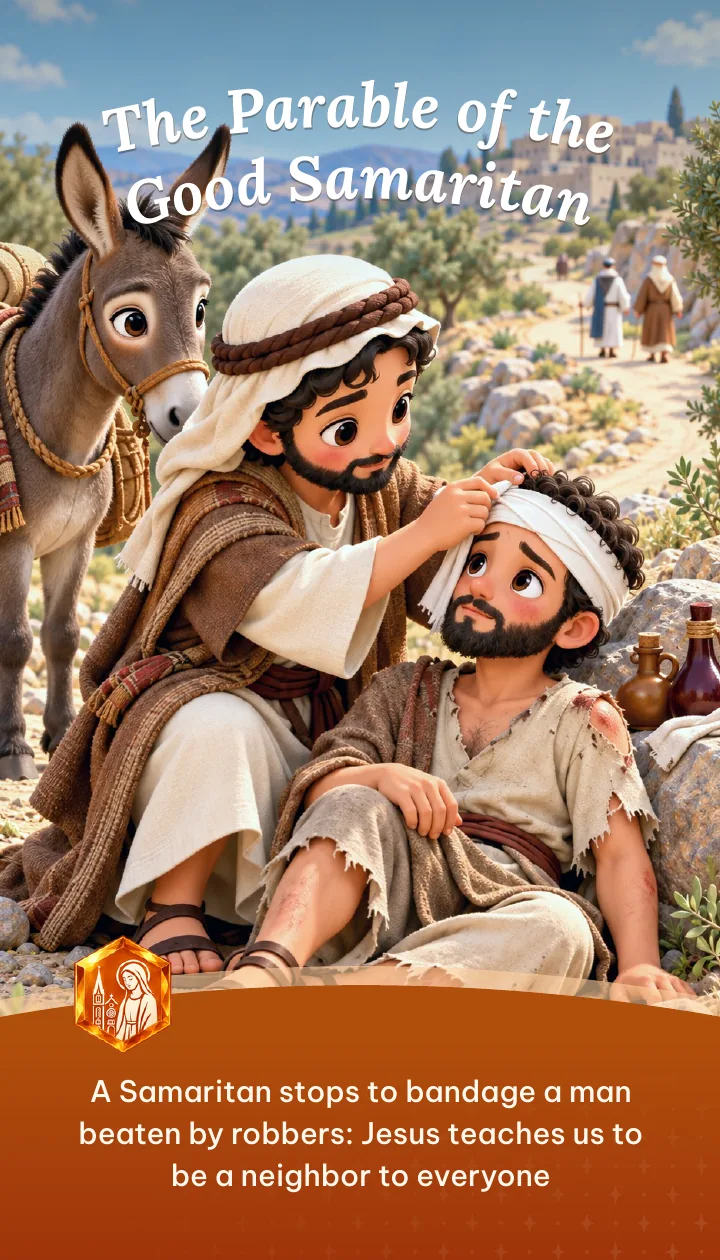
A Samaritan stops to bandage a man beaten by robbers: Jesus teaches us to be a neighbor to everyone
What is this parable?
In Jesus’ time, Jews and Samaritans did not like each other and usually kept apart. And yet the Lord chose a Samaritan to be the good character in the story. This parable answers the question: what does it mean to love your neighbor as yourself?
The story
A scholar of the law asked the Lord what he must do to inherit eternal life. He answered himself: love God with all your heart, and love your neighbor as yourself. Then he asked again: who is my neighbor? (cf. Lk 10:25-29).
Jesus tells of a man going down from Jerusalem to Jericho who fell among robbers; they stripped him, beat him and left him lying by the road. A priest came by, saw him and passed by on the other side. A Levite did the same (cf. Lk 10:30-32). “But a Samaritan traveler who came upon him was moved with compassion at the sight.” (Lk 10:33). He poured oil and wine over the wounds, bandaged them, put the man on his own animal, took him to an inn, and even paid the innkeeper to look after him (cf. Lk 10:34-35).
The Lord asked: who was a neighbor? The scholar of the law answered: the one who showed him mercy (cf. Lk 10:36-37).
What does Jesus want to teach you?
The scholar of the law wanted to know whom he had to love. Jesus turns the question around: become a neighbor to the person who needs you, whoever that person is. Real love means stopping, and giving up your time and effort for someone else. Many Fathers of the Church also saw in the Samaritan a picture of Jesus himself, who bends down to heal us.
A lesson for you
- When you see a classmate who has fallen, is being bullied or is sad, do not walk past; stop and help.
- Be kind even to classmates who are different from you, including those you do not like.
- Share what you have: your time, your things, a word of comfort.
Identifying marks
- The Samaritan kneeling to bandage the wounded man’s head: mercy does not ask who the other person is; it simply sees that he needs help and bends down to help.
- A jar of oil and a jar of wine on a rock: what we have is used to heal others (cf. Lk 10:34).
- The wounded man leaning against a rock, his clothes in tatters: your neighbor is anyone who is suffering along the road you travel.
- Two tiny figures far off on the steep road: the priest and the Levite saw him and passed by; knowing God’s law without living it is not enough.
- A donkey standing and waiting: the Samaritan is ready to give up his own place and carry the wounded man to an inn (cf. Lk 10:34).
The text on this page is the card in the Catholic Information app, word for word.
Compiled by i-Catholic · About