The Parable of the Pharisee and the Tax Collector
No fixed feast day in the calendar
Flip the card and scan the QR code on the back to open it in the app
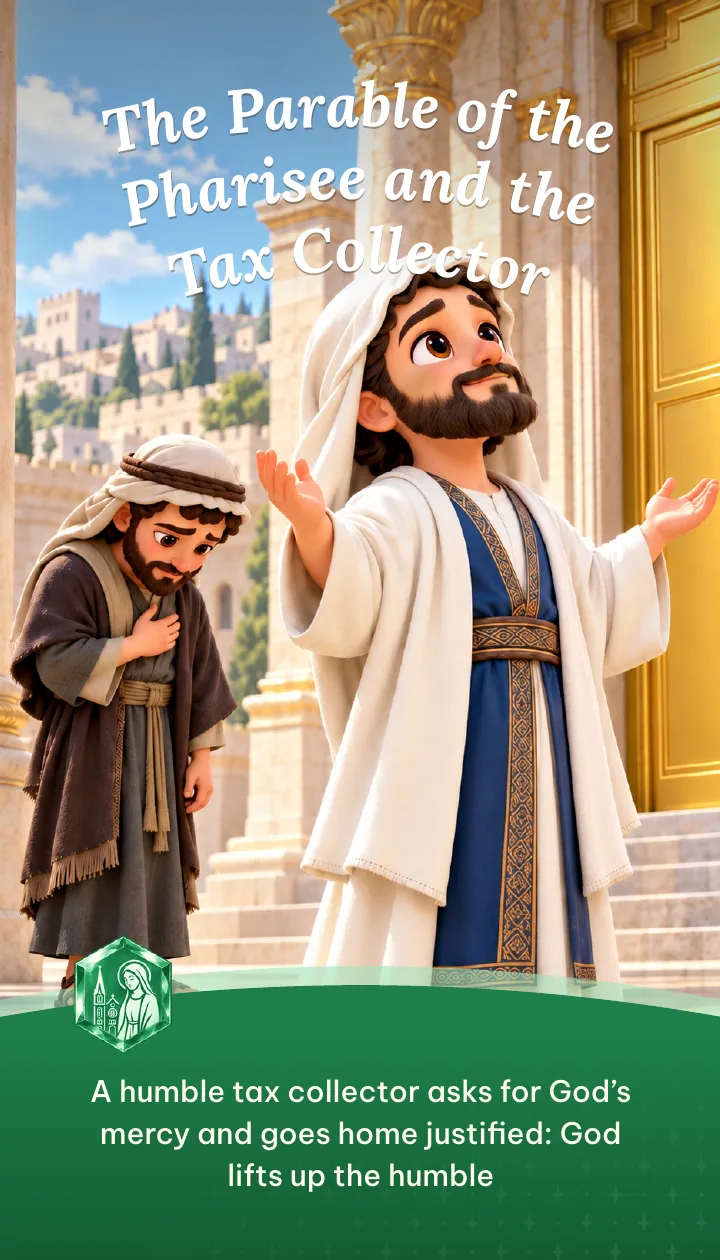
A humble tax collector asks for God’s mercy and goes home justified: God lifts up the humble
What is this parable?
Saint Luke writes that Jesus told this parable to “those who were convinced of their own righteousness and despised everyone else” (Lk 18:9). The Pharisees were people who kept the law very strictly and were respected by many. Tax collectors collected taxes for the rulers of that time, and were usually thought of as sinners and avoided by everyone.
The story
Two men went up to the Temple in Jerusalem to pray. The Pharisee stood upright and thanked God that he was not like other people, and especially not like “this tax collector”. He said that he fasted twice a week and gave a tenth of all his income (cf. Lk 18:11-12).
But the tax collector stood far off and did not even dare to raise his eyes to heaven. He beat his breast and asked God to have mercy on him, a sinner (cf. Lk 18:13). Jesus concludes: “for everyone who exalts himself will be humbled, and the one who humbles himself will be exalted.” (Lk 18:14).
What does Jesus want to teach you?
Fasting and giving offerings are good things. The Pharisee’s mistake was coming to God to show off and to look down on others, so there was no room left in his heart for God’s grace. The tax collector had nothing to show off, only an honest and sorry heart, so God gave him his grace.
At Mass, when we pray the “I confess”, we also strike our breast like the tax collector, to admit that we need God’s mercy.
A lesson for you
- When you pray, be honest with God, and admit your faults without blaming anyone else.
- Do not compare yourself with your friends to feel better than them; everyone needs God’s mercy.
- Go to confession often, and humbly ask God’s forgiveness.
- When you strike your breast at Mass, do it from the heart, remembering the tax collector’s prayer.
Identifying marks
- The tax collector standing far at the back, head bowed, hand on his chest: the humble prayer of someone who knows he is a sinner; he is the one God makes righteous (cf. Lk 18:13-14).
- The Pharisee standing upright in the middle of the court, head raised, arms spread wide: praying with outstretched arms was a normal Jewish way of praying; what was wrong was in his heart: thinking himself good, listing his good deeds and looking down on others.
- The space between the two men in the Temple court: the proud man stands close to the holy place but his heart is far from God; the humble man stands far off, but his heart is close to God.
- The shining golden door of the Temple: God is holy; whoever comes to him needs a humble heart.
The text on this page is the card in the Catholic Information app, word for word.
Compiled by i-Catholic · About