The Parable of the Unforgiving Servant
No fixed feast day in the calendar
Flip the card and scan the QR code on the back to open it in the app
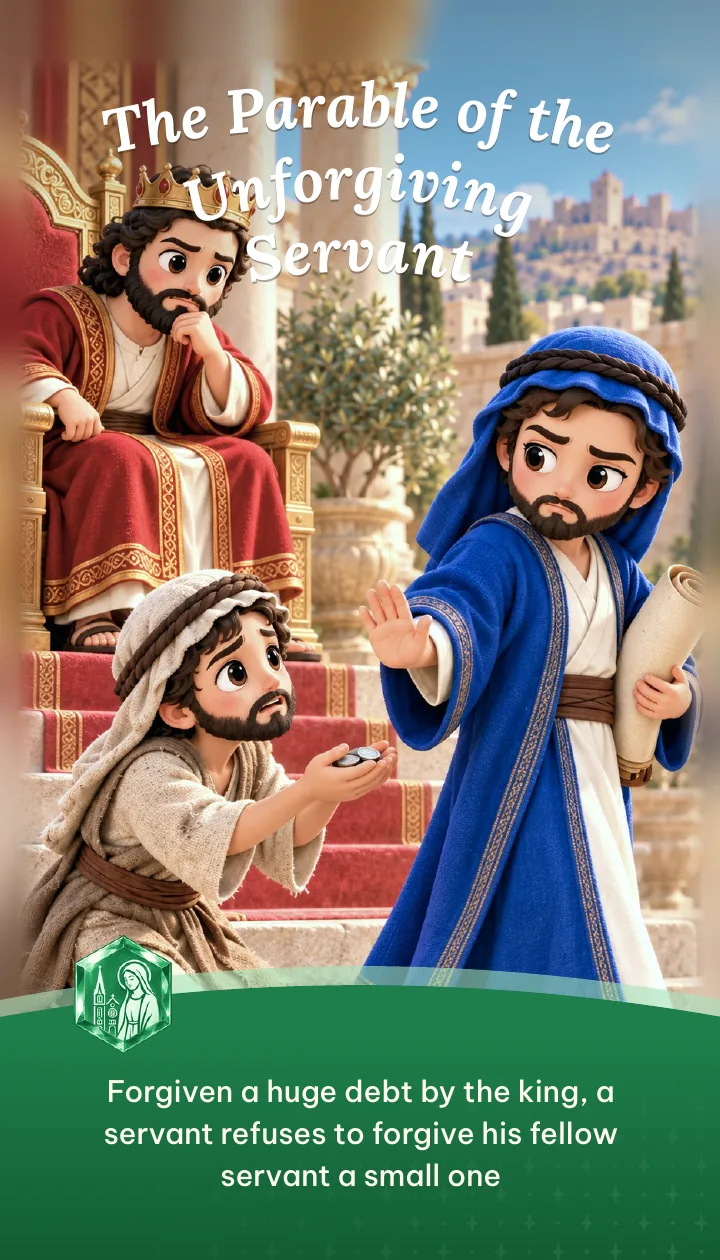
Forgiven a huge debt by the king, a servant refuses to forgive his fellow servant a small one
What is this parable?
Saint Peter asked Jesus: “Lord, if my brother sins against me, how often must I forgive him? As many as seven times?” (Mt 18:21). The Lord answered: “I say to you, not seven times but seventy-seven times.” (Mt 18:22), which means forgiving always, without counting. Then he told this parable.
The story
Jesus tells this story: a king decided to settle accounts with his servants. One servant owed the king ten thousand talents, a debt so huge he could never pay it back in his whole life. He fell down and begged, and the king was moved with compassion and forgave him the whole debt (cf. Mt 18:24-27).
As soon as he went out, he met a fellow servant who owed him only a hundred denarii. He grabbed him and demanded to be paid at once. His fellow servant fell down and pleaded: “Be patient with me, and I will pay you back.” (Mt 18:29). But he refused and even had him put in prison (cf. Mt 18:28-30).
The other servants were very upset and went to tell the king. The king called him in, scolded him for not showing mercy as he had been shown mercy, and handed him over to the torturers until he should pay back the whole debt (cf. Mt 18:31-34).
In the Gospel, the king learns what happened only when the other servants tell him. The card places the king on his throne in the background and shows the scroll of the debt as symbols, so you can see that God sees how we treat one another.
What does Jesus want to teach you?
The debt of ten thousand talents stands for our sins, which God has forgiven freely, that is, without asking anything in return. The debt of a hundred denarii stands for the wrongs other people do to you. The parable does not say that the hurts you suffer do not matter; it shows you that God’s mercy is greater than every debt. Whoever has been forgiven by God must learn to forgive their brothers and sisters. Forgiving can take time, and you can ask God to help you. If someone hurts you, tell your parents or teachers so that you are protected; forgiving does not mean putting up with what is wrong in silence. Jesus ends with a warning: our heavenly Father will treat us the same way if we do not forgive our brothers and sisters from the heart (cf. Mt 18:35). Every time you pray the Our Father, you ask God to forgive your sins as you forgive others (cf. Mt 6:12).
A lesson for you
- When a friend hurts you and then says sorry, forgive them and do not keep bringing it up.
- Before you go to bed, make peace with your brothers and sisters at home.
- When it is hard to forgive, remember how many times God has forgiven you, and ask him to help you.
Identifying marks
- A large scroll tucked under the arm of the servant in blue: the huge debt the king has just forgiven; it stands for our sins, which God has forgiven freely.
- The servant raising his hand to refuse, turning away: the narrow heart of someone who has received mercy but will not show mercy to anyone.
- His fellow servant kneeling on the steps, holding out a few coins: his friend’s small debt; Jesus makes the comparison so you can see how great God’s mercy is.
- The king, wearing a crown, seated on his throne, looking stern: God sees everything; he wants us to forgive as he himself has forgiven.
The text on this page is the card in the Catholic Information app, word for word.
Compiled by i-Catholic · About