The Wedding at Cana
No fixed feast day in the calendar
Flip the card and scan the QR code on the back to open it in the app
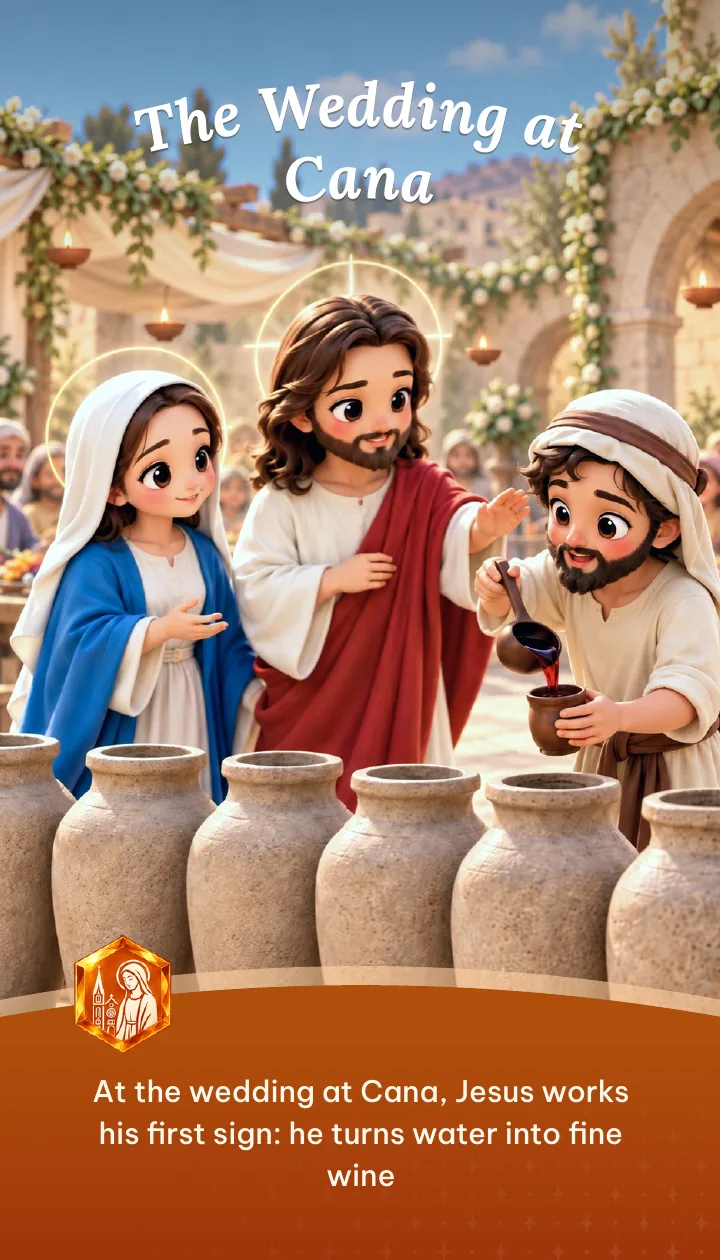
At the wedding at Cana, Jesus works his first sign: he turns water into fine wine
What is this event?
The wedding at Cana is where Jesus worked his first sign, revealed his glory, and his disciples began to believe in him (cf. Jn 2:11). This event has no feast day of its own. The Church reads it on the Second Sunday in Ordinary Time in Year C, and meditates on it in the second Luminous Mystery of the Rosary.
The story
“On the third day there was a wedding in Cana in Galilee, and the mother of Jesus was there.” (Jn 2:1). Jesus and his disciples had been invited too.
In the middle of the feast the wine ran out, an embarrassing moment for the hosts. Mary noticed and said to the Lord: “They have no wine.” (Jn 2:3). The Lord answered that his hour had not yet come (cf. Jn 2:4), but Mary still trusted, and told the servants to do whatever he said.
There were six stone jars there, each able to hold about eighty to one hundred twenty liters of water (cf. Jn 2:6). The Lord said: “Fill the jars with water.” (Jn 2:7). They filled them to the brim. Then he told them to draw some out and take it to the headwaiter. When the headwaiter tasted it, the water had become wine, and better wine than what had been served at first (cf. Jn 2:8-10).
The Gospel says that the servants drew some out and took it to the headwaiter, but it does not describe the ladle, the color of the wine or the looks on their faces; the card draws that scene so you can see the miracle.
What does Jesus want to teach you?
Jesus cares even about people’s small worries: he does not let the newlyweds’ joy be spoiled. Mary teaches you two things: to notice when others are in trouble, and to trust and do what the Lord says. Her words to the servants are the last words of Mary recorded in the Gospels, like a message from her to all her children. The Catechism of the Catholic Church teaches that the sign at Cana announces the hour of Jesus’ glorification and the new wine that becomes the Blood of Christ in the Eucharist (cf. CCC 1335).
A lesson for you
- When your family or friends are having a hard time, notice it like Mary and pray for them.
- Ask Mary to pray for you, then do what the Lord teaches.
- Pray for families, and for your parents to always love each other.
Identifying marks
- Six large stone jars in a row: water used for the Jewish rites of purification (cf. Jn 2:6); Jesus turns the old into a new joy.
- A servant ladling red wine from a jar into a cup, looking amazed: the servants had obeyed, so they knew where the wine came from (cf. Jn 2:9); whoever obeys the Lord will see what the Lord does.
- Mary holding out her hand toward the servants: she notices other people’s troubles and brings them to her Son.
- Jesus raising his hand toward the jars: at his command, water becomes fine wine; he reveals his glory.
- Garlands, lanterns and guests seated at the feast: Jesus and his Mother come to share the joy of the newlyweds; the Lord honors family and marriage.
The text on this page is the card in the Catholic Information app, word for word.
Compiled by i-Catholic · About